
Marketers are spending heavily to create demand, but too much of that demand is dying after the click, form fill, or inquiry.
The problem is not only fragmented customer journeys. It is follow-up failure. SMS messages are increasingly filtered, ignored, or treated as spam. Calls go unanswered. And when a customer misses the moment, most do not come back on their own. That means paid media can generate real intent, only for that intent to disappear before the brand has a trusted way to continue the conversation.
For CMOs, this is not a channel problem. It is a revenue leakage problem. The budget has already been spent to create the signal. The question is whether the organization can preserve that signal long enough to qualify, route, and convert it.
This is where RCS becomes relevant: not as another message format, but as a trusted conversation layer between customer intent and sales action.
RCS (Rich Communication Services) extends traditional text messaging into a verified, branded channel for multi-media, two-way customer engagement. It enables rich content, suggested actions, and conversational responses within a single thread, helping brands create a more trusted and interactive path from customer interest to next action.
RCS gives the brand a verified identity, a richer interactive experience, and a thread where the customer can reply, tap, ask questions, request help, and move toward a qualified sales interaction.
For marketing organizations, the value is practical. The gap between signal and action is where many high-intent journeys lose momentum. A customer may be interested but not ready for a live conversation. They may need reassurance that the message is legitimate. They may have a question before moving forward. They may respond better to an interactive experience that lets them choose the next step. In those moments, the branded thread creates another way to keep engagement moving while complementing the channels that brought the customer there.
Every ignored message, missed call, and abandoned follow-up path represents demand the business already paid to create. RCS matters because it gives marketers another way to keep that demand alive while intent is still active.
Centerfield’s RCS program with a leading telecommunications and internet provider shows what can happen when that channel is treated as conversation infrastructure. Across a representative month, the program ran 128,795 messages across 25,714 RCS conversations. Those conversations produced measurable engagement and buying signals: 6,210 customers engaged by replying or tapping, and 3,952 conversations showed a buying signal. Among responders, 63.6% showed an actionable buying signal.
The broader lesson is clear: when AI-powered RCS is designed as a dynamic conversation channel, it can help enterprise marketing teams interpret intent, preserve momentum, and route qualified demand with context.
In a live Centerfield program for the telco, RCS became a verified, branded, two-way channel for customer acquisition.
RCS gives marketers a practical way to protect paid demand after the signal, when customers are interested but the next interaction determines whether that intent becomes a qualified opportunity or disappears.
What changed, in plain numbers:
It supported customers who arrived through RCS-first inbound search experiences and customers who engaged after outreach. The common thread was the RCS conversation itself: a branded experience where customers could ask questions, tap actions, request an agent, or move toward a sales conversation on their own time.
That makes the telco program a useful proof point for a broader marketing question: how can brands turn digital intent into a trusted, guided next step before the customer is ready for a live interaction?
- 01
RCS reached meaningful scale.
The program ran 25,714 RCS conversations during the representative month, with 128,795 messages — 115,472 sent and 13,323 received.
- 02
Engagement translated into buying signals.
6,210 customers engaged by replying or tapping, and 3,952 conversations showed a buying signal — 63.6% of responders showed an actionable buying signal.
- 03
Speed protected momentum.
Consumer replies had a 32-second median reply time, while the AI agent replied in a median of 6 seconds. About half of qualified transfers in the broader program included an RCS touchpoint.
The important shift: RCS can be measured less like a message format and more like a conversation environment — one that captures response, interprets intent, and supports routing with context.
The operational problem: paid demand is leaking in the follow-up
High-intent demand does not convert automatically.
A customer can compare providers, click a search ad, request information, ask about availability, or show interest in many ways. But if the next step feels generic, delayed, disconnected, or hard to verify, the journey can stall before the customer converts.
That is where many acquisition funnels quietly lose value. The brand may have already paid to generate the lead or capture the visit, but the follow-up experience often depends on channels under pressure: SMS that may be filtered or ignored, calls that may go unanswered, and static pages that do not adapt to what the customer needs next.
For CMOs, the issue is not simply whether the journey is fragmented. It is whether paid demand is being stranded before it becomes a qualified conversation.
In the telco program, the branded RCS thread gave customers a more direct way to continue. The verified identity, rich content, one-tap actions, and two-way conversation helped reduce friction at the moment when the customer had to decide whether to keep engaging.
In the telco program, RCS played two roles:
- It acted as a conversation channel for prospects already in the acquisition flow.
- It became an inbound entry point from Google Search, allowing shoppers to begin directly inside a branded conversation.
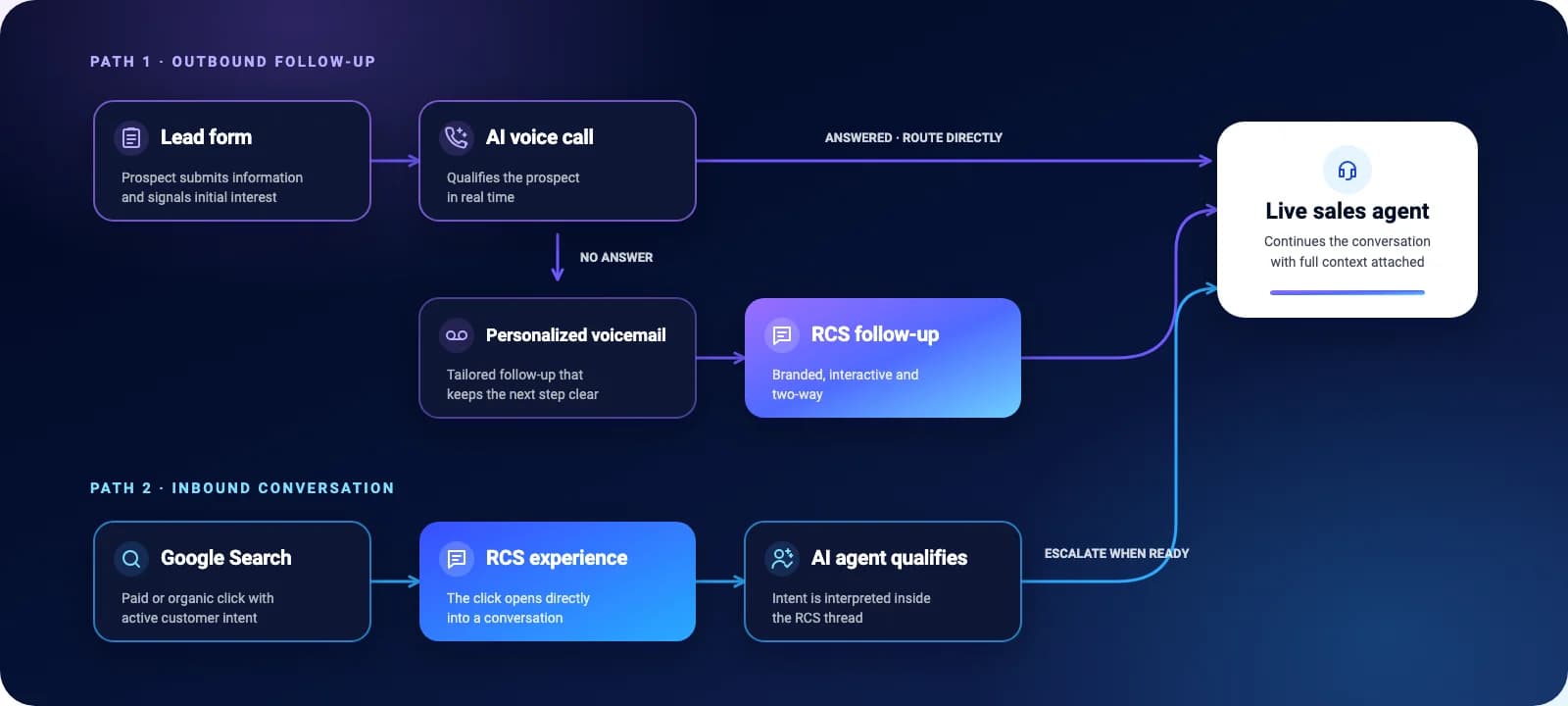
That second point is important. RCS was not only a continuation channel. It could also act as a front door for customers who were already showing interest.
For marketing teams, this is the shift: the next step after intent can be more than a page, message, or handoff. It can be a branded conversation that helps clarify readiness while the customer is still engaged.
RCS impact: from message delivery to conversation quality
The program’s core insight was practical: the channel had to feel credible before the conversation could perform.
Traditional SMS follow-up has structural limitations. Plain-text messages often arrive from anonymous short codes. Consumers increasingly ignore them, and stronger spam filtering can make deliverability harder. Even when an SMS reaches the phone, it does little to reassure the prospect that the message is connected to the brand.
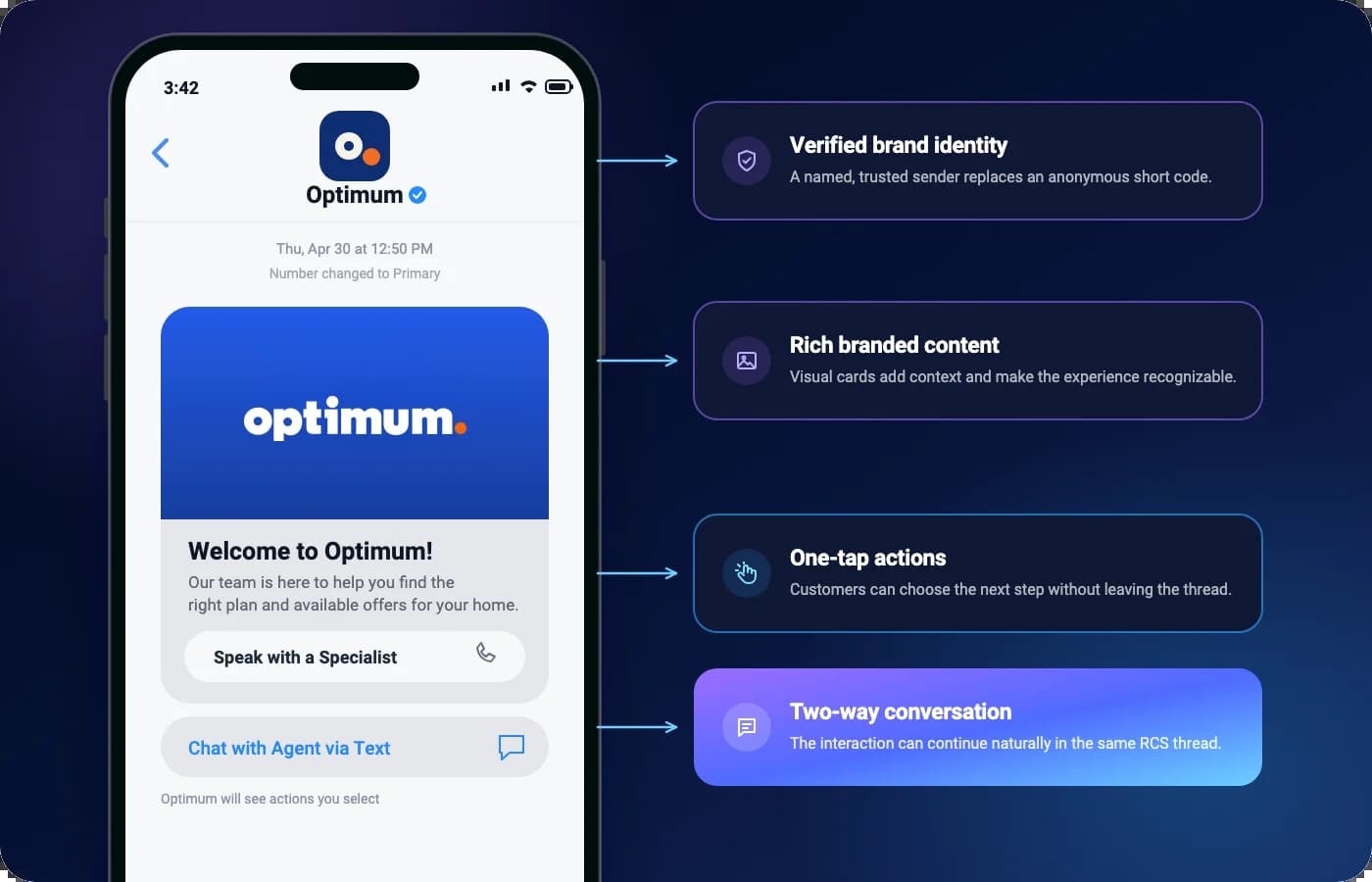
RCS changed that experience in four ways.
This is the difference between messaging as notification and messaging as infrastructure. Notification asks whether the message was sent, delivered, read, or clicked. Conversation infrastructure asks whether the interaction produced a signal that can be acted on.
In this program, RCS produced those signals.
What the RCS data shows
Across the representative month, the program ran 25,714 RCS conversations.
From those conversations, 6,210 customers engaged by replying or tapping, equal to 24.1% of all conversations. 3,952 conversations showed a buying signal, equal to 15.4% of all conversations and 63.6% of responders.
RCS engagement funnel
The strongest individual signals were requests for a live sales agent and direct sales call requests. The source report identifies about 1,793 conversations requesting a live sales agent and around 1,590 direct sales call requests.
For marketing leaders, the importance is not simply that people engaged. It is that engagement contained commercially useful information. Replies, taps, agent requests, call requests, and conversation depth all created a clearer view of readiness.
That is where AI-powered RCS speaks to enterprise expectations. For large marketing organizations, the value is in turning engagement into signals the business can actually use across the funnel.
RCS as an intake channel, and an inbound path from search
RCS can stand on its own as an intake path — and as a new inbound path from Google Search.
In the telco program, that meant RCS could support a meaningful customer conversation without another channel warming the customer first. Over the measurement window, 11,347 contacts were engaged on RCS with no paired outbound dial. Even without another channel warming them first, RCS produced meaningful engagement.
This matters because it reframes the role of RCS. It is not only a reminder or follow-up layer. It can be a branded entry point for customers who are already showing interest but need a credible, low-friction way to act.
The telco used RCS as an entry point from paid search and organic SiteLinks. Instead of routing a shopper to a static page, the click opened a one-on-one RCS conversation with the AI agent. The agent could qualify the shopper in the thread and route the person toward a sales interaction.
About 894 conversations, or 3.5% of total RCS conversations, came inbound. These conversations were largely high-intent. Around 40% were related to marketing or offers, followed by shoppers searching for new internet service at around 25%.
For marketers, this matters because it connects acquisition media to the next customer moment more directly. The customer does not have to move from ad to page to form to follow-up. The customer can move from intent to conversation.
The strategic shift is important: search, ads, and owned digital experiences do not have to end in static pages. They can open into qualification conversations that preserve context and route intent while it is active.
Speed and conversation depth as intent signals
Once a prospect replied, speed mattered.
Across the program, consumer replies came quickly. The median consumer reply time was 32 seconds. The AI agent answered even faster, with a median reply time of 6 seconds and a narrow response range.
Reply time
Across the whole program, a prospect responded after an average of 2.35 outbound touches, with a median of 1. Half responded on the very first touch. Engagement also ran across a broad daytime window, from roughly 9 AM to 8 PM ET, without requiring a human team to cover each moment manually.
The point is not only faster response time. It is operational consistency. AI-powered RCS allowed the program to keep pace with intent across more hours and more conversations than a human-only model could absorb.
The deeper the RCS conversation went, the stronger the buying signal became. The source report shows that a contact who traded a couple of messages was already more than 40% likely to ask for a representative. By about half a dozen exchanges, that likelihood approached nine in ten.
For marketing teams, that changes the measurement model. Conversation depth becomes a proxy for readiness. Replies, taps, and agent requests are not just engagement events; they are qualification inputs.
Why this matters for the CMO
For CMOs, the cost of weak follow-up is hidden in plain sight.
It shows up as paid clicks that never become conversations, form fills that stall, SMS touches that get filtered or ignored, and missed calls that rarely return. The result is not just lower engagement. It is media waste, lower conversion efficiency, and lost visibility into which customers were actually ready to buy.
RCS addresses that gap by turning the post-intent moment into a measurable conversation. Instead of asking only whether a message was delivered or clicked, marketers can see who replied, who tapped, who asked to talk, and who signaled readiness for a sales interaction. RCS is not the right layer for every interaction. It becomes especially relevant when trust, timing, and qualification all matter.
Measure buying signals, not just message activity.
Sends, reads, and clicks still matter, but they do not tell the CMO whether the customer is ready to act. In the telco program, 63.6% of responders showed an actionable buying signal — useful not only as engagement, but as a qualification layer that can identify which customers are ready for a next step.
Create a trusted path before the customer drops.
When follow-up depends on anonymous SMS, missed calls, or static pages, high-intent customers can disappear before the business learns what they needed. In the RCS-alone cohort, customers engaged without a paired outbound dial: 43% read, 19% replied, and 10% asked to talk — that suggests RCS can do more than support follow-up; it can become a front door for customers already showing interest.
Recognize readiness while intent is still active.
The financial risk is not only that customers fail to respond. It is that brands fail to recognize readiness quickly enough. Replies, button taps, agent requests, call requests, and conversation depth can all help determine when a customer is ready for a human interaction.
Remove friction, not just add features.
The most valuable RCS experiences are not necessarily the ones that use the most rich-message features. They are the ones that remove the most friction from the customer journey — eliminating a site visit, avoiding repeated form fields, reducing irrelevant product exposure, limiting unnecessary sales calls, or preventing disconnected handoffs.
Strategic viewpoint: from messaging channel to enterprise conversation layer
For years, marketing teams have optimized the path into the funnel: better targeting, sharper creative, stronger offers, more efficient media, improved landing pages.
Those still matter. But the next layer of performance may come from improving what happens after the customer shows interest.
The telco program does not prove that every category will behave the same way. It does show why the post-intent moment deserves closer attention. In a branded, interactive thread, customer engagement becomes easier to interpret: who replied, who tapped, who asked to talk, who requested an agent, who moved deeper into the conversation, and who may be ready for a next step.
That is the broader opportunity: not another isolated tool, but a capability that improves the connection between marketing intent and operational execution. The larger shift is not simply deploying a new channel. It is applying technology at the moments where customer expectations and business outcomes meet: trust, speed, qualification, and routing.
What early RCS testing is teaching Centerfield: the best use cases start with a clear moment of intent, rely on intelligence behind the conversation, remove unnecessary steps from the customer journey, and require operational infrastructure — consent, fallback, integrations, measurement, latency management, and ownership — to scale beyond a demo.
The more advanced RCS use cases also show why the message itself is not the full product. Rich cards, verified branding, and suggested replies improve the experience, but the larger value comes from the intelligence behind the conversation: customer data, product information, eligibility rules, client demand, routing logic, and measurement. The thread is where the customer engages, but the value comes from what the platform can understand and do with that engagement.
Where this model applies
The RCS model is most applicable in industries where three conditions are present.
- High intent appears before the customer is ready for a live conversation.
- Customers need a trusted, branded next step.
- Qualification depends on interpreting customer signals.
The exact entry point will vary by category. The operating model does not: understand the customer moment, preserve context, and guide the person toward the right next step.
The RCS data points to a clear conclusion: many acquisition journeys already contain intent that marketers paid to create, but cannot always see, interpret, or act on before it fades.
The strongest finding is not that every journey needs another message. It is that many journeys need a better follow-up layer — one that keeps paid demand from dying in the gap between interest and action.
Methodology
Centerfield Insights publishes one piece of proprietary research each month, drawn from data generated across Centerfield’s network of owned media properties, managed acquisition programs, and AI-driven sales infrastructure.
Our network reaches more than 250 million consumers annually and tracks 10.6 billion monthly intent signals across insurance, home security, telecom, and e-commerce. The research we publish is built on data from operating in these markets — not surveying them from the outside.
Centerfield Insights is delivered free, once per month, to acquisition leaders, CMOs, and performance marketers at Fortune 100 brands and their agency partners.
Subscribe or access the full report archive:
centerfield.com/insights
Centerfield is a digital marketing organization specializing in AI visibility, affiliate and owned media, paid media performance, and AI-driven sales conversations for Fortune 100 companies across insurance, home services, telecom, and e-commerce.
We operate the full acquisition stack — from the first intent signal to the closed conversation — and we run owned media properties reaching more than 250 million consumers annually. The data behind Centerfield Insights comes from running real programs at real scale in the markets we write about.